

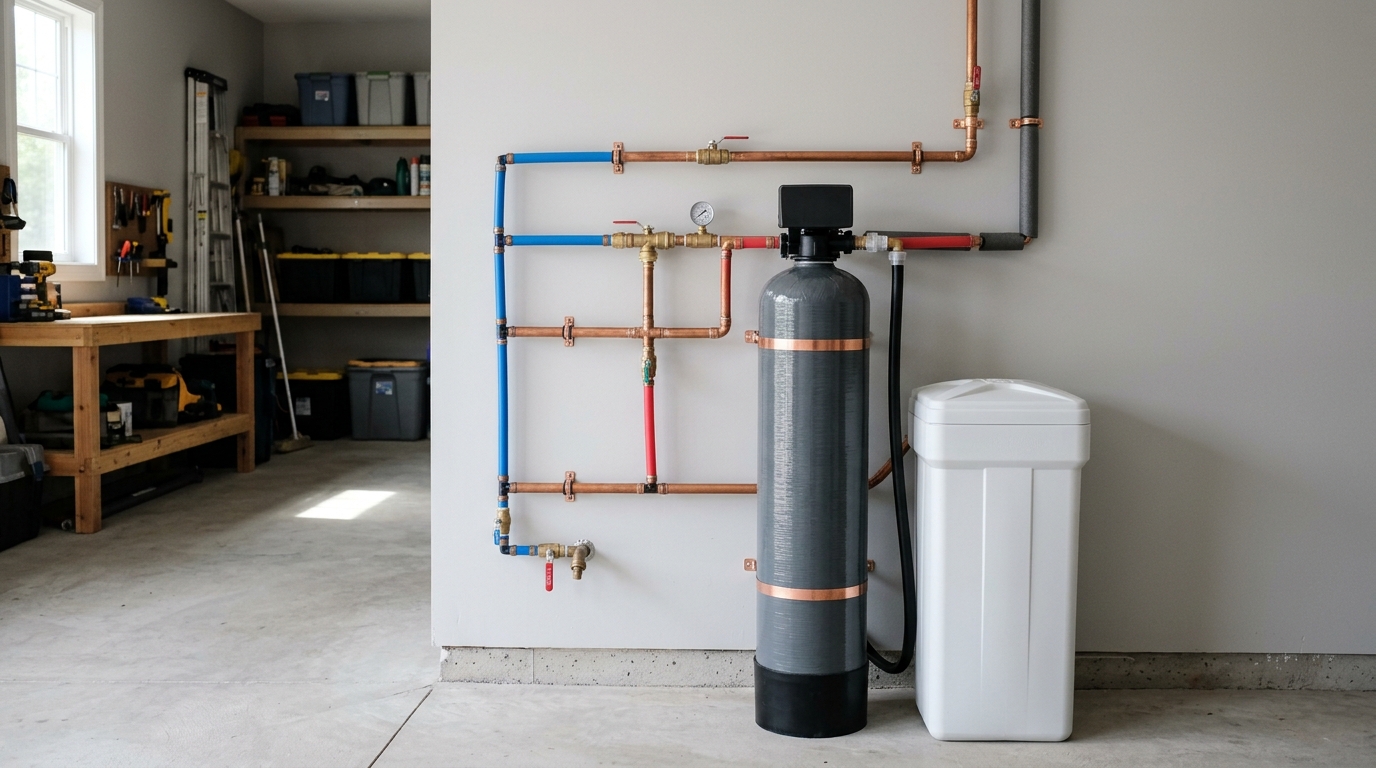
How Ion Exchange Differs From Salt-Free Conditioning
A traditional salt-based water softener passes hard water through a bed of negatively charged ion-exchange resin beads. Positively charged calcium (Ca²⁺) and magnesium (Mg²⁺) ions bind to the resin and trade places with sodium or potassium ions. Once the resin saturates, the control valve flushes brine across the bed to recharge it.
Salt-free systems—most commonly Template-Assisted Crystallization (TAC)—do not remove calcium or magnesium at all. If you test water before and after a salt-free tank with a drop-titration kit (like a Hach 5-B), your GPG hardness reading will be identical. Instead, TAC media encourages dissolved hardness ions to form microscopic inert crystals that are less likely to stick to smooth interior pipe walls.
Side-by-Side Performance & Ownership Comparison
Understanding what each category does—and cannot do—prevents buyer's remorse. The table below compares verified operational differences across real residential installs.
| Criterion | Salt-Based Softener (Ion Exchange) | Salt-Free Conditioner (TAC) |
|---|---|---|
| Lowers GPG hardness reading? | Yes (to < 1 GPG; verified under NSF/ANSI 44) | No (0 GPG reduction) |
| Stops glass spots & soap film? | Yes — removes calcium & magnesium ions | No — dried droplets still leave white mineral spots |
| Protects water heaters from scale? | High (prevents scale buildup) | Moderate (reduces adherent pipe scale; less effective in stagnant heated tanks) |
| Requires drain line & electricity? | Yes (120V GFCI outlet + air-gapped drain) | No (passive media tank) |
| Ongoing consumables | Salt pellets (~10–20 forty-lb bags/yr; ~$75–$160/yr) | Sediment pre-filter (~$25–$40/yr); media swap every 3–5 yrs |
| Clear-water iron tolerance | Handles low-to-moderate ferrous iron (4×–5× GPG/ppm) | Strict limit (~0.3 ppm max; iron coats and disables TAC media) |
Which Path Makes Sense for Your Home?
Match the technology to your measured GPG hardness and household expectations rather than marketing headlines:
- Choose a salt-based softener if your tap tests above 7.0 GPG (USGS Hard or Very Hard), you want spotless shower glass and better soap lather, or you have any measurable ferrous iron.
- Consider a salt-free TAC conditioner only if local ordinances prohibit brine discharge, you have no drain access, your hardness is modest, and your sole goal is partial pipe-scale reduction rather than soft water feel.
- If your water tests Soft (< 3.5 GPG) or Moderately Hard (3.5–7.0 GPG), skip softening entirely and focus on carbon or RO drinking-water filtration if chlorine or PFAS is your primary concern.
Check daily grain load and salt-dose operating capacities for your GPG.
Compare salt, water, equipment, and installation over 5 years.
Frequently Asked Questions
- Does a salt-free water conditioner make tap water feel soft?
- No. Salt-free conditioners leave all calcium and magnesium minerals dissolved in the water, so you will not get the slippery soft-water feel, extra soap lather, or spot-free dishes produced by ion exchange.
- How much sodium does a salt water softener add to drinking water?
- Ion exchange adds roughly 7.5–8 mg of sodium per liter for every 1 GPG of hardness removed—about 18–20 mg per 8-ounce glass at 10 GPG hardness (less than a slice of bread). Homeowners on strict low-sodium diets can install a kitchen RO faucet or use potassium chloride pellets.
- Are salt-free conditioners certified under NSF/ANSI 44?
- No. NSF/ANSI 44 applies specifically to cation-exchange water softeners that remove hardness ions. Salt-free conditioners are sometimes tested for scale-prevention efficacy under separate protocols (such as DVGW W512), not NSF/ANSI 44 hardness reduction.
Luke reads the spec sheets, NSF/WQA certification listings, municipal water quality reports and owner feedback so you don't have to, then writes it up in plain English with the trade-offs named. Reviews are research-based, not hands-on lab tests, and an affiliate commission never moves a pick.